4 Pics 1 Word
- 4.6
- Rating
- 50.00M
- Installs
- Free
- Price
 Analysis by App-foxy
Some word games ask me to build answers from a rack of letters, while others depend almost entirely on a dictionary. 4 Pics 1 Word sits in a more visual middle ground: I look at four images, search for the idea they share, and then arrange the available letters into the answer. That simple setup makes it easy to understand within seconds, but the better puzzles still make me pause, question my first impression, and look for a less obvious connection.
After spending time with it, I see why this free word game has reached such a wide audience. It is light enough for a short break, yet flexible enough to become a regular habit. The presentation is clean rather than dramatic, and the game’s mood comes from the steady rhythm of observing, guessing, correcting, and moving on. I would recommend it to anyone who enjoys visual associations more than traditional crossword grids, although players looking for a deep story, competitive action, or completely uninterrupted play may find it too modest.
How the pictures turn into a playable language
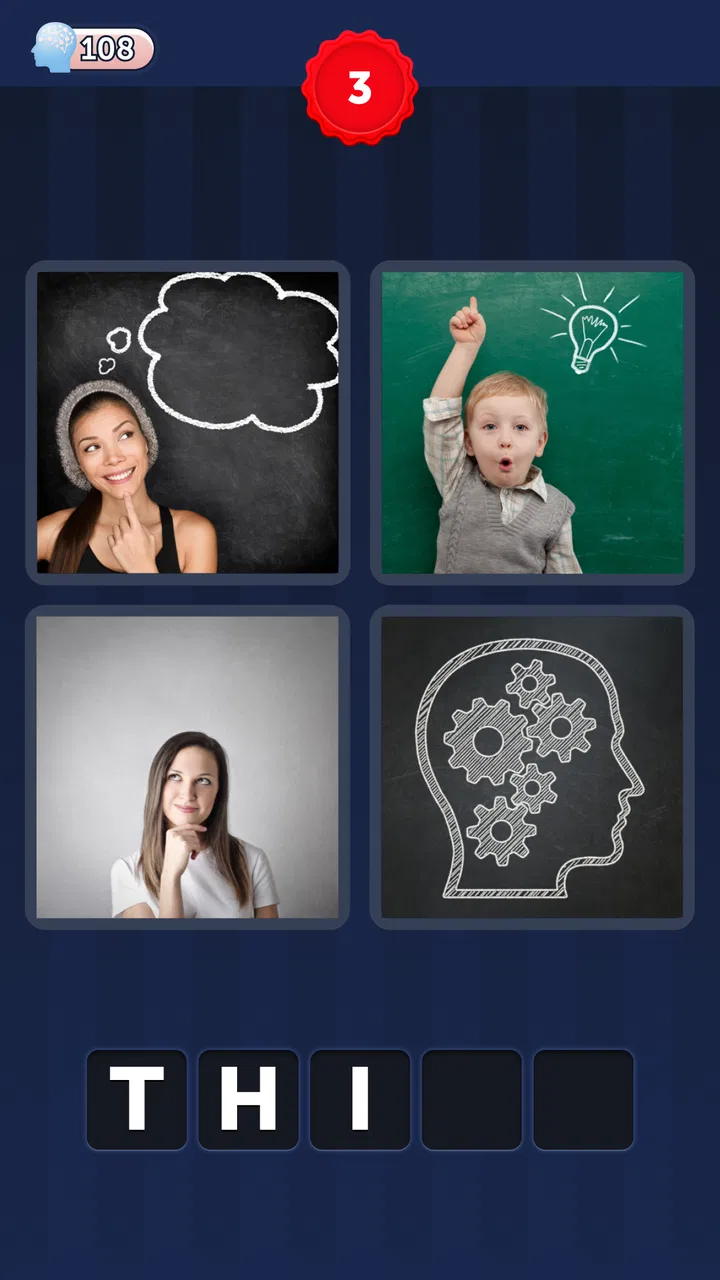
The central idea is immediately readable. Four pictures appear together, and each one offers a clue toward one shared word. The images might point to an object, an activity, a quality, or a broader concept. A row of empty answer spaces and a group of mixed letters give the puzzle its boundaries. I like this format because it removes unnecessary instructions: the pictures teach me how to play before any lengthy explanation is needed.
You May Also Like

 AccuWeather: Weather Radar
AccuWeather Review: A Quick, Clear Forecast for Everyday Decisions
For everyday plans, the best forecast is the one you can understand quickly. AccuWeather makes rain timing, radar, and local conditions easy to act on, with a few trade-offs.

 Hill Climb Racing
Why Hill Climb Racing Still Turns Crashes Into One More Run
A tiny car, a bumpy hill and one more upgrade: Hill Climb Racing keeps resurfacing because its simple chaos makes every near-miss feel personal.

 AliExpress - Shopping App
AliExpress Makes Global Shopping Feel Personal, but Shoppers Bear the Risk
AliExpress turns a global marketplace into a pocket-sized discovery engine. Its reach is useful, its shopping loop compelling, and its trade-offs easy to miss.

 Lords Mobile: Kingdom Wars
Lords Mobile Is a Kingdom-Building Routine, Not a Quick Match
A case-by-case verdict on the building, battles, device demands, and social commitments that make Lords Mobile rewarding for some players and exhausting for others.

 PDF Scanner app - TapScanner
TapScanner Makes Paperwork Easier to Capture, Check, and Share
TapScanner makes scanning with a phone feel less like a rescue operation and more like a dependable step in getting work done. Its capture tools are useful, though not flawless.

 Block Blast!
 Shows How Much a Puzzle Game Can Leave Out
A quiet grid game shows why puzzle players increasingly value instant clarity, repeatable skill and low-pressure play—and where the genre still needs to catch up.
More From Our News Desk
View All News


The art direction supports that clarity. Each image has a practical role, and the four-picture arrangement encourages comparison instead of letting me focus on a single clue. The visual language is not built around a fictional world or a cast of characters. Instead, it turns ordinary visual references into a small vocabulary system. A photograph of an item can suggest its use, a scene can suggest an action, and several unrelated-looking images can converge on an abstract word.
That approach creates an interesting kind of uncertainty. In a normal image-matching game, I might identify what I see and stop there. Here, identifying the objects is only the first step. I have to ask what they have in common, whether the answer should be a noun or another type of word, and how the letter slots narrow the possibilities. The pictures provide the atmosphere, but the letters keep the experience grounded in word reasoning.
This is also where the game can be more demanding than its cheerful appearance suggests. A picture may have several possible interpretations, and the intended answer is not always the first word that comes to mind. When I get stuck, I find it more useful to describe each image aloud or mentally than to stare at the group as one large clue. Breaking the puzzle into four small observations often reveals a connection that was hidden by the overall composition.
A visual mood built for quick attention
The setting is deliberately broad and familiar. Rather than placing the player in a fantasy map or an elaborate narrative, the game uses recognizable images as its environment. That choice makes the experience approachable for a wide range of ages, which fits its Everyone content rating. It also means I can start a puzzle without needing to remember characters, locations, or previous events.
There is a trade-off here. The lack of a strong fictional setting keeps the focus on the word challenge, but it also limits emotional attachment. I do not play to discover a story or explore a world. I play because I want to solve the next visual association. For me, that is a strength during a commute or a short rest, but it may feel thin to someone who expects a game to provide narrative progression and a richer sense of place.
The images themselves carry most of the visual personality. Their job is to be recognizable enough to invite a guess while still leaving room for interpretation. When that balance works, the art feels efficient rather than decorative. I am not distracted by unnecessary animation or busy scenery. When the balance does not work for me, the puzzle can feel vague instead of clever, especially if several pictures depend on a specialized meaning.
One useful habit is to separate recognition from association. I first name what is visibly present, then look for a shared action, material, mood, or context. This two-pass method is more reliable than trying to force a word from the first image. It is a small change, but it makes the visual design feel more interactive because I am actively translating pictures into language rather than merely guessing at them.
Sound, feedback, and the pace of a short session
The audio design is understated, which suits the game’s purpose. There is no need for a large musical score to explain what is happening. The main rhythm comes from the player’s own pauses and the feedback after entering an answer. I can think quietly, submit a guess, receive confirmation or correction, and immediately decide whether to continue. That restrained structure helps the game fit naturally into spare moments.
I appreciate that the pacing is not built around fast reflexes. A difficult puzzle gives me room to inspect the images and rearrange possibilities without feeling that I have failed because I was slow. The game’s tension is mental rather than physical. Even when I solve an easy clue quickly, the transition to the next one keeps the momentum moving without turning the experience into an action game.
That calm pace also makes it suitable for shared play. I can show a puzzle to another person and discuss the possible connection without needing to hand over a complicated control scheme. In a family setting, one person may recognize a picture while another spots the word pattern. The game becomes a small conversation, and the four-image layout works well for that because everyone can refer to the same visible clues.
The limitation is that players who want a strong sense of escalation may find the rhythm repetitive. The basic action remains familiar from one puzzle to the next: inspect, form a word, enter it, and continue. The satisfaction comes from the individual clue rather than from a changing control system. I would choose a more animated word game when I wanted dramatic pacing, but I prefer this quieter structure when I want my attention on language.
Why the mechanics fit the mood
The controls are simple enough that the challenge stays where it belongs: in interpretation. I am not learning a complicated interface while also solving the puzzle. The available letters act as a useful filter, preventing the images from becoming completely open-ended. Even if I understand the general theme, the number of spaces and the letter pool help me test whether my idea is plausible.
That combination of visual clues and constrained spelling is the game’s strongest mechanical decision. Pictures invite broad thinking, while letters demand precision. If I only relied on the images, many answers could seem possible. If I only had letters, the game would resemble a conventional anagram exercise. Together, the two systems create a compact reasoning loop that feels distinct from both picture trivia and standard word searches.
I also find the game useful as a low-pressure form of word practice. It encourages me to notice synonyms, categories, and relationships between concrete things and abstract ideas. I would not treat it as a formal language course, because solving a clue depends on recognizing the intended association rather than studying structured lessons. Still, it can be a pleasant way to keep vocabulary active, especially for players who learn more comfortably through images.
Hints can change the experience from a pure test of deduction into a resource-management decision. When I am stuck, I have to decide whether to keep exploring the clue or use help and preserve my time. I recommend waiting before spending assistance on a puzzle that feels merely unfamiliar. Often, writing down several possible connections mentally is enough to make the intended answer visible. Saving help for genuinely ambiguous clues makes each tool feel more meaningful.
The game is free to download, with in-app purchases ranging from $0.99 to $42.99 per item. That matters because a player’s preferred style will determine how comfortable the experience feels. Someone who enjoys sitting with a difficult clue can play more patiently and avoid turning every obstacle into a purchase decision. Someone who wants constant forward movement may be more aware of the temptation to use paid assistance. I would approach the game as a free puzzle first and treat purchases as optional convenience rather than part of the core appeal.
Who will enjoy it, and who should look elsewhere
I think it is especially well suited to people who like word association, visual riddles, and short sessions with a clear endpoint. It works for a quick morning distraction, a quiet evening activity, or a shared puzzle with a child or friend. The Everyone rating and straightforward presentation make it accessible, while the harder connections give experienced word-game players enough reason to keep examining the clues.
A realistic use case for me is playing several puzzles while waiting for an appointment. I can begin immediately, stop after one answer, and return later without needing to reconstruct a complicated plot. On another day, I might use it as a break from reading because it changes the kind of attention I use: instead of following paragraphs, I compare images and search for a common verbal idea. That change is small but refreshing.
I would be more cautious about recommending it to someone who dislikes ambiguity. The intended word may feel obvious only after the answer is revealed, and a player who expects every clue to have one visually literal interpretation could become frustrated. It is also not the best choice for someone seeking multiplayer competition, a long-form campaign, or a strong narrative setting. A crossword-style game may be better for players who prefer clue wording, while an anagram game may suit those who want letters to be the main source of information.
It is worth knowing that the game’s simplicity does not mean every puzzle is equally easy. Some clues depend on a shared concept rather than a direct object name, so progress can vary sharply from one screen to the next. I prefer that variation because it prevents the format from becoming automatic, but players who want a predictable difficulty curve may find the jumps uneven. My practical advice is to treat a stubborn puzzle as a change of viewpoint problem, not just a vocabulary problem.
Practical details before installing
The game comes from Lotum GmbH and is available free of charge. It was released on February 13, 2013, and the current version is 63.37.0. Compatibility starts with Android 7.0, so owners of older devices should check their operating system before expecting to install it. These details make it a relatively approachable option for people using an older supported phone rather than a brand-new device.
Its scale is reflected in an average rating of 4.6 from around 1.3 million ratings, alongside more than 164 thousand written reviews and over 50 million installs. Those figures do not replace personal taste, but they do suggest that the visual-word format has remained appealing to a large audience. I would still judge it by the kind of puzzle experience I want: broad popularity cannot turn an ambiguous clue into a satisfying one for every player.
One question many new players have is whether the game is suitable for very short sessions. In my experience, yes, because the individual puzzle structure does not demand a long uninterrupted commitment. Another is whether strong spelling skills are enough to succeed. They help, but visual interpretation is just as important; knowing many words will not always solve a clue if the shared idea has not been identified.
Players may also wonder how to improve without immediately relying on hints. I suggest looking for relationships between all four pictures rather than solving them one at a time. If three images suggest a category and the fourth seems unrelated, that fourth image may be pointing toward an action, adjective, or secondary meaning. This is one of the game’s more valuable lessons: the odd clue is often not a mistake but the part that shifts the answer away from the obvious category.
My final take on its atmosphere and staying power
What holds the experience together is the agreement between its presentation and its mechanics. The images create a friendly, everyday visual world; the restrained feedback keeps the mood calm; and the letter system turns loose impressions into a precise answer. Nothing is trying to overpower the puzzle. I can focus on the small moment when several unrelated pictures suddenly become one word.
That focus is also the reason I would not call it a complete all-purpose game. Its appeal depends on enjoying the same basic loop repeatedly, and its atmosphere is more functional than immersive. I would choose it over a traditional word search when I want visual reasoning, but I would choose a narrative puzzle game when I want a world to explore. The right comparison is not which game is universally better, but whether I want language to emerge from images or from written clues and letters alone.
For me, the best way to play is patiently: study the composition, name the visible details, search for the relationship that links them, and use the letter pattern as a final check. That approach reveals more depth than the simple interface initially suggests. The strongest part of the experience is the moment when recognition turns into a precise word.
Overall, I find 4 Pics 1 Word an easy game to recommend for casual visual-word puzzling. It is free, approachable, supported on Android 7.0 and above, and comfortable in both solo and shared situations. Its limitations are clear, especially the repetitive structure, occasional ambiguity, and optional purchase pressure, but those issues do not undermine its central charm. If you want a quiet, picture-led challenge that can fill five minutes or become a longer solving session, this is a coherent and dependable choice.
FAQs for 4 Pics 1 Word
01What is 4 Pics 1 Word and how do you play it?
4 Pics 1 Word is a casual word puzzle game in which you examine four images and find the single word connecting them. Each puzzle provides a group of letter tiles, and you tap the letters in the correct order to form your answer. The concept is easy to understand, but later levels require careful observation, vocabulary knowledge, and the ability to recognize less obvious connections between pictures.
02Is 4 Pics 1 Word free to download and play?
Yes, 4 Pics 1 Word can generally be downloaded and played for free on Android and iOS devices. However, the game may include optional in-app purchases, advertisements, or paid features connected with hints and additional assistance. You can progress without spending money, although players who use hints frequently may encounter limits on free resources or invitations to purchase extra coins.
03Does 4 Pics 1 Word work without an internet connection?
Many puzzles in 4 Pics 1 Word can be played offline after the relevant game content has loaded, making it suitable for travel, commuting, or areas with unreliable connectivity. An internet connection may still be required for advertisements, updates, cloud-related features, events, or in-app purchases. Offline availability can vary by version and device, so it is worth testing the game before relying on it without mobile data.
04Are hints available if I cannot solve a puzzle?
Yes, 4 Pics 1 Word offers hint-style assistance to help when the four images are difficult to interpret. Depending on the version, hints may remove incorrect letters, reveal part of the answer, or provide another form of guidance. These tools are useful for keeping your progress moving, but they usually consume coins or another in-game resource, so using them selectively is advisable.
05Is 4 Pics 1 Word suitable for children and families?
4 Pics 1 Word is generally family-friendly and can be an enjoyable way to practice spelling, vocabulary, visual recognition, and lateral thinking. Nevertheless, the difficulty and word choices vary, and younger children may need help with advanced vocabulary or abstract clues. Parents should also review the app’s advertising, optional purchases, and privacy settings before allowing children to play independently.
Pros
- Simple gameplay that is easy to understand from the first puzzle.
- Thousands of puzzles provide plenty of content for casual play.
- Works well in short sessions during commutes or breaks.
- Helpful hints can get you past especially difficult word puzzles.
- Colorful images make the game accessible for a wide range of ages.
Cons
- Some puzzles rely on word associations that may feel vague or subjective.
- Hints and extra guesses can become limited without watching ads or spending coins.
- Frequent advertisements may interrupt the flow between puzzles.
- Difficulty can vary sharply
- with some levels feeling much harder than others.
- Progress may feel repetitive if you play for long periods at once.

4 Pics 1 Word
Gallery